Skip to content
Personalised assessment

Vitamin B12: energy, nervous system and duo with B9

Capture d ecran 2026 07 07 a 16
Energy and blood formation

vitamin B12 plays a key role in normal energy metabolism, in reducing tiredness and fatigue, and in the normal formation of red blood cells — a precious support in the life of a woman and a mother.

Nervous system and methylation cycle

it contributes to the normal functioning of the nervous system and to normal homocysteine metabolism, working in close synergy with vitamin B9, to help limit the risk of silent deficiency.

Active form methylcobalamin

At Jolly Mama, you will find vitamin B12 in its methylcobalamin form, directly usable by your body — a reassuring choice to secure your intake, particularly for vegetarian or vegan women.

Origin and description

Vitamin B12, or cobalamin, is a water-soluble vitamin distinguished by the presence of a cobalt atom at the heart of its structure.

Cofacteur de plusieurs enzymes clés, elle joue un rôle central dans le métabolisme énergétique, dans la formation des globules rouges, dans le fonctionnement normal du système nerveux et dans le métabolisme de l'homocystéine, en duo avec la vitamine B9. Cette polyvalence en fait une alliée discrète à chaque étape de la maternité, de la préconception à la grossesse, puis du post-partum à la périménopause. La cobalamine existe sous plusieurs formes (méthylcobalamine, adénosylcobalamine, hydroxocobalamine, cyanocobalamine), dont seules certaines sont directement actives dans vos cellules. Sa forme et sa qualité conditionnent une bonne assimilation : on privilégie une matrice claire, une forme bien absorbée et une fabrication tracée. Un apport régulier de cette vitamine permet de couvrir les besoins de votre organisme et de soutenir le bon fonctionnement de plusieurs systèmes.

Sous forme naturelle, la vitamine B12 se trouve quasi exclusivement dans les aliments d'origine animale : foie de veau (autour de 60 µg pour 100 g), maquereau (environ 19 µg pour 100 g), saumon (environ 3 µg pour 100 g), œuf (1,9 µg), fromages affinés comme l'emmental (3,1 µg) et produits laitiers, selon les données de la table Ciqual de l'ANSES. Son assimilation dépend de plusieurs facteurs : la matrice du repas, votre statut digestif, la production de facteur intrinsèque par l'estomac et votre état nutritionnel global, ce qui peut faire varier la quantité réellement utilisée par l'organisme. Une cuisson prolongée à la chaleur, certains modes de conservation ou des régimes excluant les produits animaux peuvent rendre cet apport plus inégal d'un jour à l'autre. Une carence en vitamine B12 peut alors s'installer progressivement, avec des symptômes longtemps discrets touchant l'énergie, le système nerveux ou la formation des globules rouges. Pour les femmes végétariennes strictes ou véganes, l'alimentation seule ne suffit pas à couvrir les besoins en cette vitamine : un complément régulier devient un repère utile, sans culpabilité, pour stabiliser le taux de B12.

En complément alimentaire, la vitamine B12 se présente sous deux formes principales : la cyanocobalamine, forme synthétique très répandue qui doit d'abord être convertie par le foie, et la méthylcobalamine, forme active naturelle directement utilisable par les enzymes de votre organisme. La méthylcobalamine présente une rétention cellulaire intéressante et participe directement au cycle des méthylations, en duo avec la vitamine B9 sous forme active. Chez Jolly Mama, la vitamine B12 est apportée sous forme méthylcobalamine dans les multivitamines, ce qui contribue à une bonne biodisponibilité. Cette forme se retrouve par exemple dans nos compléments grossesse complets et nos compléments de vitamine B9 (duo des méthylations). Côté qualité, on regarde la forme exacte de la cobalamine, la pureté des matières premières, la traçabilité et l'absence d'additifs superflus.

Apports satisfaisants en vitamine B12 par stade de vie

  • Femme adulte (18+) : 4 µg/jour (source : EFSA 2015)
  • Grossesse : 4,5 µg/jour (source : EFSA 2015)
  • Allaitement : 5 µg/jour (source : EFSA 2015)
  • UL (limite supérieure de sécurité) : Non établie (source : EFSA)

Méthylcobalamine vs cyanocobalamine : ce qui les distingue

  • Forme directement active : Méthylcobalamine = oui, coenzyme directe / Cyanocobalamine = non, conversion hépatique nécessaire
  • Origine : Méthylcobalamine = forme naturelle / Cyanocobalamine = forme synthétique
  • Rétention cellulaire : Méthylcobalamine = bonne rétention / Cyanocobalamine = plus faible
  • Présence d'un groupe cyanure résiduel : Méthylcobalamine = non / Cyanocobalamine = oui, en très petite quantité

Astuce mama : La vitamine B12 ne travaille jamais seule : elle fonctionne en duo avec la vitamine B9 dans le cycle des méthylations, central en préconception et en grossesse. L'idée n'est donc pas d'apporter l'une sans l'autre, mais bien d'associer B9 et B12 sous formes actives (méthylcobalamine et folates actifs type Quatrefolic®). C'est cette logique qui guide nos multivitamines féminines, pensées pour que ces deux vitamines avancent ensemble, à votre rythme et selon l'étape que vous traversez.

À retenir : La vitamine B12, ou cobalamine, est une vitamine hydrosoluble qui joue un rôle clé dans le métabolisme énergétique, dans la formation des globules rouges et dans le fonctionnement normal du système nerveux. Selon l'EFSA, les apports satisfaisants sont de 4 µg/jour chez la femme adulte, 4,5 µg/jour en grossesse et 5 µg/jour en allaitement. Comme cette vitamine se trouve quasi exclusivement dans les aliments d'origine animale, un apport régulier est un point de vigilance important pour les femmes végétariennes ou véganes, afin d'éviter une carence silencieuse. Chez Jolly Mama, la vitamine B12 est apportée sous forme active méthylcobalamine.

clothilderedon 32

Products containing it

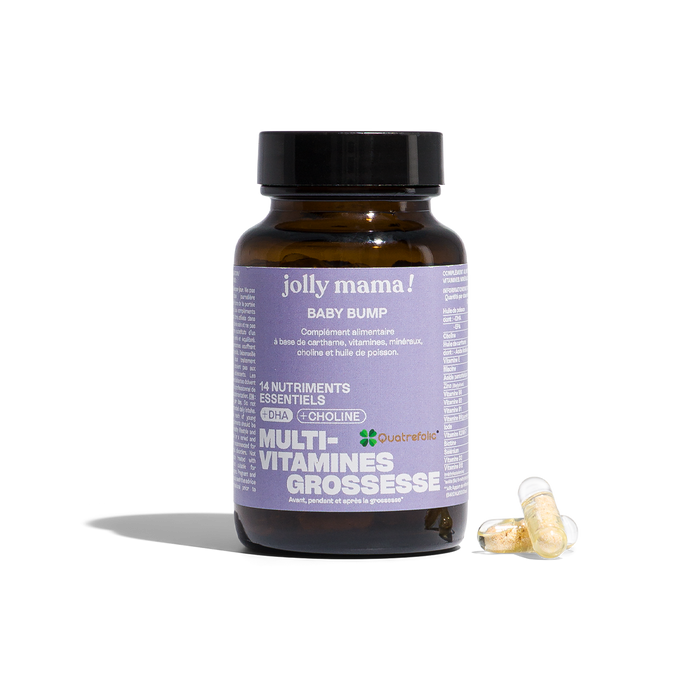
  • Baby Bump Gélules complément alimentaire
    -15%
    Best seller
    Add

    Baby Bump

    Multivitamines DHA grossesse & fertilité

    14 nutriments essentiels + DHA + Choline

    Formule 3-en-1 ultra complète avec capsule duocaps ™

    Baby Project
    Pregnancy

    from

    £32.29

    £39.98

    Add
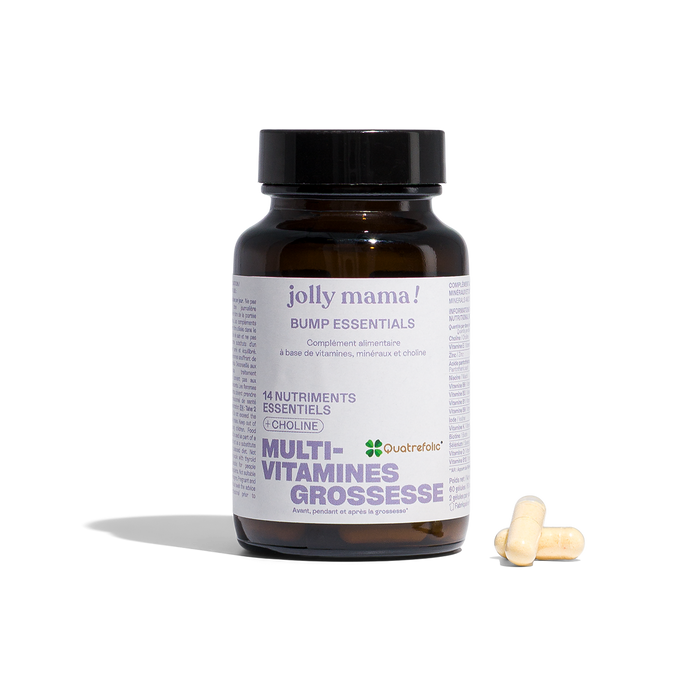
  • Bump essentials femme enceinte prenant 2 gélules de Bump essentials, le complément grossesse
    -25%
    Add

    Bump essentials

    Multivitamines vegan grossesse & fertilité

    15 nutriments clés, dont choline et folates hautement biodisponibles

    100 % vegan et sans DHA

    Baby Project
    Pregnancy

    from

    £18.92

    £27.81

    Add
  • Bump powder femme enceinte préparant Bump powder multivitamines grossesse en poudre
    -30%
    Iodine-free
    Add

    Bump powder

    Multivitamin powder for conception & pregnancy

    15 nutriments clés, dont choline et folates hautement biodisponibles

    100 % vegan et en poudre, idéale en cas de nausées

    Baby Project
    Pregnancy

    from

    £20.69

    £30.42

    Add
  • Post Essentials verre d'eau avec 2 gélules dans la main
    -15%
    Best seller
    Add

    Post Essentials

    Post-partum multivitamin supplement

    17 nutrients in their best forms

    Covers post-birth nutritional needs and reduces fatigue

    Breastfeeding
    Post-partum

    from

    £23.17

    £28.68

    Add
  • Mama essentials Mama essentials
    -20%
    New
    Iodine-free
    Add

    Mama essentials

    Multivitamin supplement for women

    15 highly bioavailable vitamins and minerals

    100% vegan formula

    For everyone

    from

    £13.31

    £17.38

    Add
  • Péri Essentials photo of the perimenopause dietary supplement
    -20%
    New
    Iodine-free
    Add

    Péri Essentials

    Perimenopause vitamin supplement

    Before, during and after the menopause

    17 essential nutrients

    (Peri)menopause

    from

    £19.95

    £26.08

    Add
  • Pink Balance Pink Balance
    -20%
    Add

    Pink Balance

    Complément équilibre hormonal

    À base de maca, shatavari et vitamines B

    100% bio et naturelle

    Baby Project
    Happy Cycle

    from

    £19.95

    £26.08

    Add

Why is vitamin B12 your ally throughout motherhood?

  • Energy metabolism

    Vitamin B12 contributes to normal energy metabolism and to the reduction of tiredness and fatigue — a welcome support when life as a woman and a mother demands so much.

  • Red blood cell formation

    It contributes to the normal formation of red blood cells, in synergy with iron and vitamin B9, which supports the normal functioning of the body.

  • Nervous system

    It contributes to the normal functioning of the nervous system, in connection with its role in the production of myelin, which protects nerve fibres.

  • Psychological functions

    Vitamin B12 contributes to normal psychological functions, a particularly useful property during phases when mental load is more pronounced.

  • Methylation cycle

    It plays a role in normal homocysteine metabolism and works in tandem with vitamin B9 in the methylation cycle, which is central to maternal health.

How does it work? (The science bit)

Once ingested, vitamin B12 follows a very particular journey through the body: it binds to a protein produced by the stomach, known as intrinsic factor, which accompanies it to the end of the small intestine — a region called the ileum — where it is absorbed. It then enters the bloodstream and can be stored in the liver, making it a vitamin the body knows how to set aside when intake is regular. This mechanism also explains why a compromised digestive status, certain long-term treatments or a diet low in animal products can reduce useful B12 intake over the long term, with no immediate signal.

In terms of its effects, vitamin B12 acts as a cofactor for enzymes involved in DNA synthesis, red blood cell maturation, maintenance of the myelin sheath of the nervous system and the methylation cycle. Within this cycle, it works closely with vitamin B9 to contribute to normal homocysteine metabolism. It is this B9 + B12 synergy in their active forms that explains their combination in our multivitamins: supplying one without accounting for the other can disrupt metabolism. Prolonged deficiency in this vitamin can affect the functioning of red blood cells and the nervous system, with symptoms that are sometimes subtle and develop over time. As part of a varied diet, a regular intake of cobalamin may support your vitality, your nervous system and the quality of your recovery, within formulas designed for women at every stage of life.

Did you know: The liver of a healthy adult stores an average of 2 to 3 mg of vitamin B12, which corresponds to several years' worth of reserves — typically 3 to 5 years for a woman with a balanced diet. This is why a B12 deficiency can develop very gradually, with no immediate sign. For strictly vegetarian or vegan women, a regular intake in active form is particularly valuable, especially during periods of higher demand such as preconception, pregnancy and breastfeeding.

Your questions, our answers.

Vitamin B12 is a cofactor involved in energy production, the formation of red blood cells, and the maintenance of the nervous system. On a daily basis, it contributes to normal energy metabolism, the reduction of fatigue, and the normal functioning of the nervous system. It is a discreet vitamin that works in the background of your vitality and inner balance, closely linked to your diet.

Adequate intakes of vitamin B12 increase slightly during pregnancy (4.5 µg/day) and breastfeeding (5 µg/day), compared with 4 µg/day for adult women according to EFSA. As this vitamin is found almost exclusively in foods of animal origin, strict vegetarian or vegan women may have a particular interest in a regular intake in its active form, especially during preconception, pregnancy and breastfeeding.

At the doses recommended in a well-designed food supplement formula, vitamin B12 is generally well tolerated. The EFSA has not established an upper safety limit, owing to insufficient data to identify a toxicity threshold in healthy adults. Adequate intakes are just a few micrograms per day, far below the high doses sometimes used in certain medical protocols.

A few sensible guidelines: follow the dosage indicated on the label, avoid taking several supplements containing vitamin B12 without advice, and take into account any ongoing treatments that may affect its absorption. In the case of a digestive condition, long-term treatment, pregnancy, breastfeeding, a strict vegetarian diet, or any doubt, seek advice from a healthcare professional who can assess your individual situation.

Cyanocobalamin is a widely used synthetic form that must first be converted by the liver before it can be used by cells. Methylcobalamin, on the other hand, is a naturally active form of vitamin B12, directly usable by your body's enzymes and well retained by cells. This form is particularly interesting for women with a slower metabolism or following a diet low in animal products, which is why it was chosen for our women's multivitamins.

Symptoms of a vitamin B12 deficiency often remain subtle for several years before becoming clearly apparent. They may include persistent fatigue, a drop in energy, a feeling of sluggishness, and sometimes tingling in the extremities. These signs are never specific to cobalamin, but levels that are too low can also affect the functioning of the nervous system and the formation of red blood cells. A blood test remains the most reliable way to check your status if you have any concerns.

added to basket
Continue shopping